
Unlikely Vessels Day #21: Habakkuk — The Wrestling Watchman on the Rampart

“O Lord, how long shall I cry, and You will not hear? Even cry out to You, ‘Violence!’ and You will not save. Why do You show me iniquity, and cause me to see trouble? For plundering and violence are before me; there is strife, and contention arises. Therefore the law is powerless, and justice never goes forth. For the wicked surround the righteous; therefore perverse judgment proceeds.” — Habakkuk 1:2–4 / “Though the fig tree may not blossom, nor fruit be on the vines; though the labor of the olive may fail, and the fields yield no food; though the flock may be cut off from the fold, and there be no herd in the stalls—yet I will rejoice in the Lord, I will joy in the God of my salvation. The Lord God is my strength; He will make my feet like deer’s feet, and He will make me walk on my high hills.” — Habakkuk 3:17–19 (NKJV)
THE JOURNEY
The backdrop of Habakkuk’s dialogue is the late seventh century BC in Judah, caught in the geopolitical upheaval between the declining Assyrian power and the violent rise of the Neo-Babylonian Empire. Internally, the spiritual reforms of Josiah had eroded after his untimely death, plunging Jerusalem back into systemic oppression, judicial bribery, and rampant violence. Unlike other prophets who addressed their oracles outward to a rebellious populace or backsliding monarchs, Habakkuk turned his face upward, interrogating the Almighty Himself. The Hebrew name Habakkuk (Ḥăḇaqqûq) derives from a root meaning “to embrace” or “to wrestle.” True to his name, he clung to God with intense intellectual and spiritual agony, refusing superficial piety: “O Lord, how long shall I cry, and You will not hear?… Why do You show me iniquity, and cause me to see trouble?”
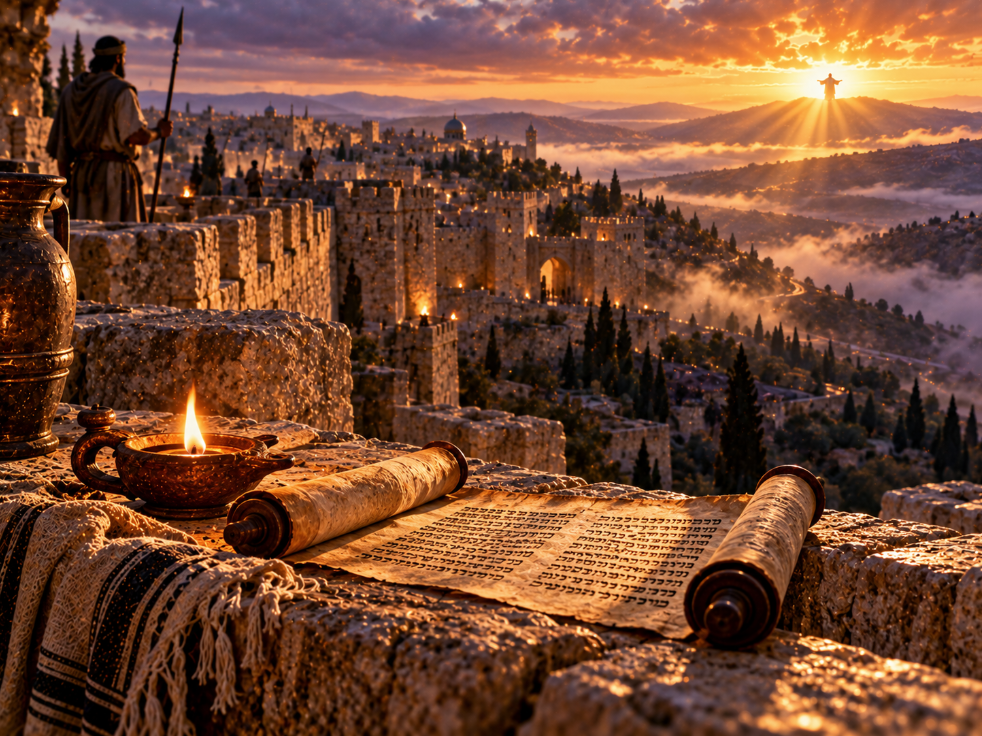
When Yahweh answered that He was raising up the Chaldeans (Babylonians)—a ruthless, bitter nation whose horses were swifter than leopards—to execute divine judgment, Habakkuk’s perplexity exploded into profound moral disorientation. How could a holy God, whose eyes are too pure to look on evil, use a pagan superpower more wicked than Judah to swallow up those more righteous than they? Rather than abandoning his faith in bitter cynicism, Habakkuk climbed up to his watchtower (māṣôr), stationed himself upon the stone ramparts, and waited to see what God would say to his complaint. The Lord answered with the foundational compass of biblical faith: “the just shall live by his faith” (we-ṣaddîq be-’ĕmûnātô yiḥyeh), warning that though the vision tarry, it will surely come. This divine encounter transformed Habakkuk’s intellectual paralysis into prophetic transcendence. By chapter 3, facing impending military invasion and systemic famine—where the fig tree fails, olive crops rot, and stalls stand empty—the trembling watchman lays down his complaints to dance with supernatural joy: “yet I will rejoice in the Lord… He will make my feet like deer’s feet, and He will make me walk on my high hills.”
Heart of the Matter
Habakkuk’s stone watchtower represents those seasons where your theology collides violently with reality. You look at suffering, global injustice, unpunished wickedness, or the collapse of your personal security, and your prayers seem answered only with silence or increasingly difficult circumstances. Religious culture often shames honest questioning, equating perplexity with lack of faith and demanding that believers put on a manufactured smile. When God’s methods contradict your expectations, you feel the chronic exhaustion of cognitive dissonance, tempted to slide into theological resentment or walk away from faith entirely.
The revelation of The Wrestling Watchman on the Rampart demonstrates that honest wrestling is not the enemy of faith; it is often the very forge where mature covenant trust is born. God did not strike Habakkuk down for asking “Why?” and “How long?” God met him on the watchtower because Habakkuk brought his doubts directly to the altar rather than turning to cynical detachment. Faith is not the absence of questions; it is the decision to cling to God’s character when His ways are incomprehensible. The climax of Habakkuk’s book contains no change in external circumstances—the Babylonian armies were still coming, and economic famine was still imminent. The breakthrough was internal: moving from demanding explanations to finding delight in the Person of God Himself. Look at the signature track record: the God of Habakkuk does not require you to suppress your pain; He meets you on the ramparts of honest prayer, steadies your footing when the foundations crumble, and gives you deer’s feet to leap over the high hills of devastation.
Faith in Action
The identity of the believer is applied when we stop conditioning our praise on favorable circumstances and begin anchoring our joy in the unchanging character of God.
The Challenge: Explicitly identify the unresolved question, unanswered prayer, or area of chronic uncertainty where you have been questioning God’s methods, and make a conscious choice to offer unconditional, rejoicing trust today.
- Station Yourself on the Rampart: The moment anxiety, frustration, or cynical questioning begins to overwhelm your mind today, halt immediately. Declare aloud: “I will not anchor my faith in what I understand. I anchor my trust in who God is.”
- Declare the “Even If” Praise: Bring your worst-case scenario before God—even if the bank account drops, the contract falls through, or circumstances fail to improve. Proclaim out loud that your joy is tethered to the God of your salvation, not to external outcomes.
- The Watchman’s Song of Trust Prayer: Find a quiet space, stand upright with your feet planted firmly and your hands raised slightly in a posture of resolved triumph, and pray: “Sovereign Father and Holy One of Israel, You are the God from everlasting, whose eyes are too pure to approve evil and whose sovereign providence governs all human history. I confess that I have often grown bitter, anxious, and confused when Your ways did not align with my timelines or expectations. Forgive me for demanding explanations while withholding my trust. Today, like Habakkuk on the ramparts, I bring my honest questions to You and choose to wait on Your Word. Even if the fig tree does not blossom, even if the fields yield no food, and even if my resources fail—yet I will rejoice in the Lord! You are my strength. Steady my trembling heart, make my feet like deer’s feet, advance Your Kingdom through my stubborn praise, and let my unwavering joy in the midst of trials be an eternal monument to Your sovereign faithfulness. Amen.”
Prayer for the Day
Sovereign Lord and Unshakable Refuge, You are the God whose ways are unsearchable and whose judgments are past finding out, yet whose steadfast love endures forever, and Your eternal character is my permanent ground. I confess that I easily allow world events, delayed answers, and unexpected trials to disturb my peace and tempt me to doubt Your goodness. Wash away my chronic skepticism, my demand for control, and my fear of the unknown today. Give me the profound, quiet composure to stand watchful upon the ramparts of faith, trusting that the vision will speak in its appointed hour and will not lie. I rest securely in Your unyielding Word, confident that You will equip my feet with supernatural agility to walk victoriously across the highest hills. Amen.
SIGNATURE DECREE
“…yet I will rejoice in the Lord, I will joy in the God of my salvation. The Lord God is my strength; He will make my feet like deer’s feet, and He will make me walk on my high hills.” — Habakkuk 3:18–19 (Our Memorial Translation: “The painful silence of unanswered questions and the threat of earthly ruin hold zero power to steal your song; the Great I AM establishes your footing upon the rampart, turning your deepest perplexity into the victorious praise of deer’s feet leaping upon high hills.”)