
Faithfulness Day #10: The Jar That Never Emptied

“Then the word of the Lord came to him: ‘Go at once to Zarephath in the region of Sidon and stay there. I have directed a widow there to supply you with food.’ …When he came to the town gate, a widow was there gathering sticks. He called to her and said, ‘Would you bring me a little water in a jar so I may have a drink?’ As she was going to get it, he called, ‘And bring me, please, a piece of bread.’ ‘As surely as the Lord your God lives,’ she replied, ‘I don’t have any bread—only a handful of flour in a jar and a little olive oil in a jug. I am gathering a few sticks to take home and make a meal for myself and my son, that we may eat it—and die.’ Elijah said to her, ‘Don’t be afraid. Go home and do as you have said. But first make a small loaf of bread for me from what you have and bring it to me, and then make something for yourself and your son. For this is what the Lord, the God of Israel, says: “The jar of flour will not be used up and the jug of oil will not run dry until the day the Lord sends rain on the land.”‘” — 1 Kings 17:8–14 (NIV)
THE JOURNEY
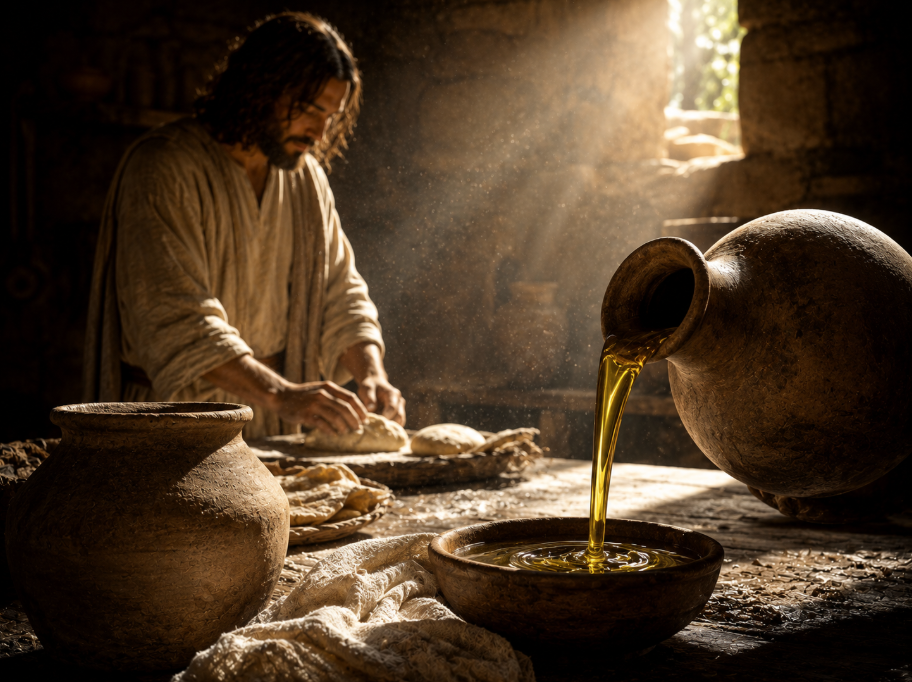
The backdrop of this narrative is an unyielding, regional famine that had pushed the most vulnerable members of society to the absolute brink of starvation. In the pagan territory of Zarephath, a destitute widow had reached the literal end of her rope. The prolonged drought had completely dried up her options, destroyed her economy, and left her kitchen bare. When the prophet Elijah encountered her at the town gate, she was gathering a few sticks to prepare one final, meager meal for herself and her young son. Her calculation was grim and definitive: they would eat their remaining handful of flour and drop of oil, lay down, and wait for death to take them.
But where human math calculated absolute finality, the unshakeable faithfulness of God introduced a supernatural multiplier. The Lord had sent Elijah to this specific house not because the widow had an abundance to give, but because God had an abundance to perform through her. Elijah presented a radical, high-stakes demand: “Feed me first, then feed your family.” It was an invitation to risk her last earthly safety net on the bare word of a promise. In an extraordinary act of desperate obedience, she baked the bread and handed it over. Instantly, the divine track record overrode the laws of consumption. Day after day, as she reached into the jar, there was always another handful of flour; every time she tipped the jug, oil poured out. God sustained an entire household through the worst of the famine from a jar that human eyes declared empty.
Heart of the Matter
The jar at Zarephath represents the terrifying space where you are asked to give, serve, or step out in faith when you feel completely depleted. It is the moment God asks you to show kindness when your own heart is broken, to give financially when your budget is tight, or to pour out your energy to help someone else when you feel utterly exhausted. In those moments of deep depletion, anxiety screams that if you let go of the little bit you have left, you will be left with absolutely nothing and ruin will follow.
But the mystery of the never-emptying jar reveals that God’s supply is unlocked through our willingness to release what we are clutching. God does not wait for you to have a surplus before He asks for your obedience; He uses your scarcity as the canvas for His miracle. When you put God’s purposes first, your meager resources shift from a human expiration date to a divine ecosystem. You stop living out of the limited volume of the container and start living out of the infinite capacity of the Provider. Look at the track record: the hand that holds your future can make a single handful of faith last through an entire season of drought.
Faith in Action
The faithfulness of God is applied when we stop hoarding our last resources out of panic and start pouring them out in obedience.
The Challenge: Bake a “first loaf” of obedience with whatever small resource you have left today.
- Stop Measuring the Bottom: Identify the specific area where you are constantly tracking your deficit (e.g., your patience, your finances, or your creative capacity). Refuse to stare at the bottom of the jar today, declaring: “My supply is small, but God’s treasury is limitless.”
- Give out of the Deficit: Intentionally offer a portion of your remaining strength or resource to someone else today. Send an encouraging text, give an unexpected gift, or lend a hand, trusting that your supply will be replenished.
- The Multiplying Prayer: Find a quiet space, open your hands wide, and pray: “Sovereign Sustainer, You are the God of the Endless Supply. I confess my fear of running out, and how tightly I hold onto my last drops of energy, patience, and money. Forgive my hoarding heart. Today, I choose to trust Your word over my empty containers. I give You my ‘handful’ today and ask You to stretch it. Keep my jar from emptying and my jug from running dry in this season, and let my life be a monument to Your miraculous daily care. Amen.”
Prayer for the Day
God of the Daily Bread, You are the One who measures the waters in the hollow of Your hand and fills the hungry with good things. I confess that I easily panic when I look into my life and see only empty shelves and dwindling resources. Wash away my survival mindset today. Give me the radical, courageous faith of the widow to obey You even when it costs me my last safety net. I trust that as I put Your Kingdom first, You will personally oversee my storehouses and keep me perfectly sustained until the rain returns. Amen.
THE STONE OF REMEMBRANCE
“The jar of flour was not used up and the jug of oil did not run dry…” — 1 Kings 17:16 (Our Memorial Translation: “Human survival hoards the last handful; Covenant faith gives it away, discovering that the Provider’s supply chain has no bottom.”)