
Grace Day #26: The Heavy Coat

“The Lord is close to the brokenhearted and saves those who are crushed in spirit.” — Psalm 34:18 (NIV)
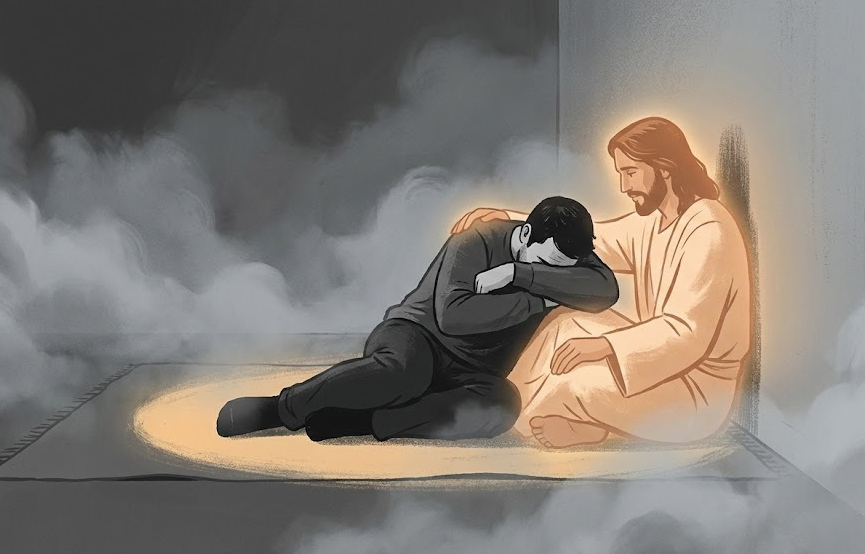
The Journey
I have always been the guy with the smile. At church, I’m a greeter. I’m the one who hands out the bulletins with a firm handshake and a loud, “God is good!” I believed that joy was the primary proof of faith. If you loved Jesus, you should be happy.
But three months ago, a fog rolled into my life that I couldn’t pray away.
It wasn’t triggered by a specific tragedy. I didn’t lose my job. My family was healthy. But I woke up one morning feeling like I was wearing a lead coat. Everything required effort. Getting out of bed felt like lifting weights. The colors of the world seemed muted, turned down to a dull grey.
I tried to fix it spiritually. I read more scripture. I listened to upbeat worship music until my ears rang. I rebuked the “spirit of heaviness.” But the fog remained.
Sunday mornings became the hardest time of the week. Standing in the sanctuary, surrounded by people raising their hands and singing about victory, I felt like a fraud. What is wrong with me? I thought. I must be sinning. I must not trust God enough. If I had real faith, I wouldn’t feel this hollow.
I became a master of the Christian mask. “How are you, Mark?” “Blessed and highly favored!” I’d lie, while inside I was screaming for help.
The crash came on a Wednesday night. I was supposed to lead a small group discussion on “The Joy of the Lord.” I sat in my car in the church parking lot, gripping the steering wheel, unable to open the door. The panic attack hit me like a physical blow—chest tight, breath short, tears streaming down my face.
I couldn’t go in. I couldn’t fake it one more time.
I saw a figure walking across the lot. It was Pastor Tom, the senior pastor who had retired a few years ago but still attended. He saw me hunched over the wheel. He tapped on the glass.
I rolled down the window, humiliated. “I’m sorry, Pastor. I’m just… I’m having a moment.”
Tom opened the door. “Scoot over,” he said.
He got in the passenger seat. He didn’t ask what was wrong. He just sat there while I hyperventilated, waiting for my breathing to slow.
“I think I’m losing my faith,” I whispered finally. “I don’t feel any joy. I just feel… heavy. darkness. I feel like God has left the building.”
Tom looked out the windshield. “Do you know who Charles Spurgeon was?” he asked.
“The Prince of Preachers?” I said, confused.
“The very one,” Tom nodded. “Ideally, the most ‘faithful’ man of his century. He led thousands to Christ. And yet, he spent weeks at a time unable to get out of bed because of depression. He called it his ‘fainting fits.’ He once said, ‘There are dungeons beneath the Castle of Despair.'”
Tom turned to me. “Mark, Elijah prayed to die. David flooded his bed with tears. Jesus wept in the garden until he sweat blood. Sadness is not a sin. It is not a lack of faith. It is a human condition.”
“But I feel so far from God,” I admitted.
“That’s because you’re looking for Him in the light,” Tom said gently. “But Psalm 23 says He walks with us through the valley of the shadow of death. He isn’t waiting for you at the exit, Mark. He’s walking in the fog with you.”
Tom drove me home that night. He helped me make an appointment with a counselor. He helped me tell my wife the truth about the “heavy coat” I had been wearing.
I didn’t get better overnight. I had to do the work—therapy, honesty, and eventually, medication to help rebalance my brain chemistry. I learned that taking an antidepressant is no more shameful than a diabetic taking insulin.
But the biggest healing was spiritual. I stopped trying to perform happiness for God. I started bringing Him my heaviness. I realized that my brokenness didn’t repel Him; it drew Him closer. The Lord is close to the brokenhearted—not to fix them instantly, but to hold them while they heal.
I still have grey days. But I don’t hide them anymore. I found that when I took off the mask, I didn’t lose my community. I found it. Because it turns out, half the people in the pews were wearing heavy coats too, just waiting for someone to say it was okay to admit they were tired.
Heart of the Matter
The stigma of mental health in the church is a heavy burden. We often conflate “joy” (a spiritual fruit) with “happiness” (an emotion). When we confuse the two, we unintentionally shame those struggling with depression or anxiety, making them feel like bad Christians.
But the Bible is not a book of constant smiles. It is a book of grit, lament, and honest suffering. God created us as complex beings with bodies, minds, and spirits. Sometimes the spirit is willing, but the brain chemistry is weak.
Mark learned that his depression didn’t disqualify him from God’s love. In fact, it gave him a new depth of empathy. We must remember that seeking help—whether through counseling or medicine—is not a rejection of God’s power; it is the utilization of God’s common grace. You do not have to “pray away” a broken leg, and you do not have to “pray away” a broken chemistry. You treat it, and you invite Jesus into the healing process.
Faith in Action
We often ask “How are you?” as a greeting, not a question.
The Challenge: Today, reach out to one person who is usually the “strong one”—the one who helps everyone else. Text or call them and ask: “I know you’re always checking on others, but how are you really doing today? No ‘church answers’ allowed.”
Create a safe space for someone to drop their mask for five minutes.
Prayer for the Day
Man of Sorrows, You are acquainted with grief. You know the weight of the heavy coat. I lift up my mind and my emotions to You. When the fog rolls in, remind me that I am not alone. Thank You that my tears do not offend You. Give me the courage to seek help when I need it, and the grace to be patient with myself while I heal. Be my light in the darkness, even if that light is just enough for the next step. Amen.
Grace Note
“I have learned to kiss the wave that throws me against the Rock of Ages.” — Charles Spurgeon