
Grace Day #22: The Honor of the Towel

“Even to your old age and gray hairs I am he, I am he who will sustain you. I have made you and I will carry you; I will sustain you and I will rescue you.” — Isaiah 46:4 (NIV)
The Journey
The hallway smelled like lavender lotion and bleach. It is a specific scent combination that I will forever associate with the hardest year of my life.
I was forty-five years old, squeezed into what sociologists call the “Sandwich Generation.” On one side, I had two teenagers who needed rides to soccer and help with algebra. On the other side, I had my father.
Dad had been a giant of a man—a steelworker, a deacon, the kind of guy who could fix a transmission with a wrench and a prayer. But dementia is a cruel thief. It hadn’t just stolen his memory; it was slowly stealing his dignity. He had moved into our spare bedroom six months ago when it became unsafe for him to live alone.
My life became a blur of doctor appointments, pill organizers, and sleepless nights. I was exhausted. I was grieving the father I had lost while taking care of the shell that remained.
The breaking point happened on a Thursday morning. I was already late for work. I was trying to get Dad dressed, but he was confused and resistant. He didn’t recognize me. He thought I was a stranger trying to hurt him.
“Get away!” he shouted, swiping his hand at me. He knocked a bowl of oatmeal off the nightstand. It splattered across the carpet and onto my work slacks.
I froze. The oatmeal dripped down my leg. I looked at the clock. I looked at the mess. I looked at my father, who was now huddled in the corner of the bed, looking small and frightened.
I wanted to scream. I wanted to walk out the door and keep driving. I didn’t sign up for this, I thought bitterly. I am not a nurse. I am a daughter. This is too hard.
I went into the bathroom, locked the door, and slid down to the floor. I cried the ugly, silent tears of pure burnout. “I can’t do this, God,” I whispered. “I have nothing left. He doesn’t even know who I am. What is the point?”
I sat there for ten minutes, waiting for the strength to stand up. Then, my eyes landed on the towel hanging on the rack.
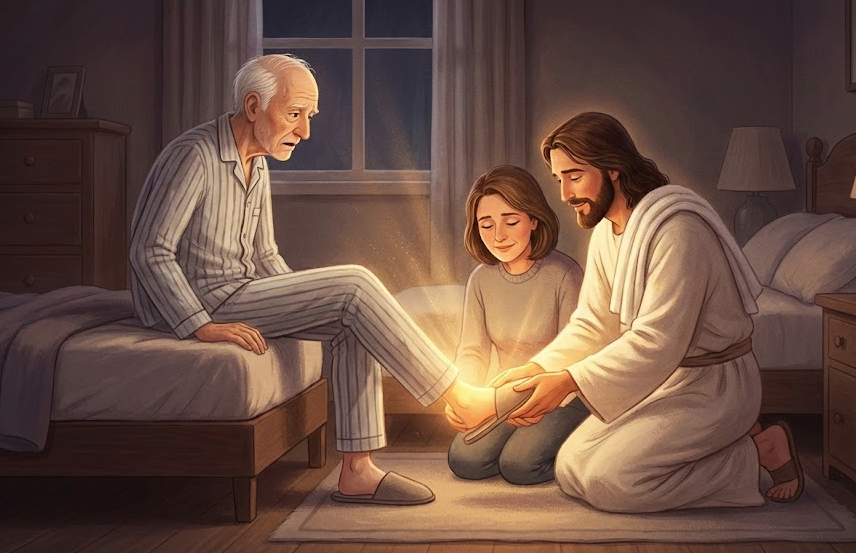
I remembered a story from Sunday School—Jesus in the Upper Room. He knew He was the King of Kings. He knew He held all power. And what did He do with that power? He didn’t demand to be served. He stripped off his outer robes, wrapped a towel around his waist, and knelt down to wash the dirty, calloused feet of his friends. Even the feet of Judas.
The honor of the towel.
A quiet thought pressed into my heart: When you serve him, you are serving Me. And remember… he once changed your diapers. He once cleaned up your spilled milk. He carried you when you were helpless. Now, you get the holy privilege of carrying him home.
The resentment didn’t vanish instantly, but the perspective shifted. I wasn’t just cleaning up oatmeal; I was participating in the cycle of grace.
I stood up. I washed my face. I changed my pants. I walked back into the bedroom.
Dad was still sitting on the edge of the bed, picking at the quilt. He looked up at me, wary.
I didn’t try to rush him. I didn’t use my “hurry up” voice. I knelt down in front of him, right in the mess on the floor. I took his trembling, paper-thin hands in mine.
“It’s okay, Dad,” I said softly. “It’s just oatmeal. We can fix it.”
I saw his shoulders drop. The fear in his eyes was replaced by relief.
“I… I made a mess,” he whispered, his voice sounding like a child’s.
“I know,” I smiled. “I’ve made plenty of messes in my life, too. Let’s get you cleaned up.”
I spent the next twenty minutes helping him wash and dress. I missed my meeting at work. But as I buttoned his flannel shirt—the same way he must have buttoned my coat when I was three—I felt a profound, heavy peace settle over the room.
He looked at me when we were done. For a fleeting second, the fog lifted. His eyes cleared, and he saw me. “You’re a good girl, Sarah,” he said clearly. “Thank you.”
Then the fog rolled back in, and he asked where his mother was.
But I had that moment.
I learned that caregiving is the hardest work I will ever do. It is a slow, often invisible martyrdom. But it is also the place where I am most like Jesus. When I kneel down to serve someone who can offer me nothing in return—not even recognition—I am standing on holy ground.
Heart of the Matter
Caregiving is often called “the long goodbye.” It is a season characterized by invisible labor and compounded grief. You are mourning the person while they are still there. It is easy to feel trapped, resentful, and forgotten by God.
But Sarah’s revelation in the bathroom points to the “Theology of the Towel.” In a world that values autonomy and strength, the Gospel values dependency and service. Jesus taught that greatness is not found in how many people serve you, but in how many people you serve.
When you care for an aging parent, a sick spouse, or a child with special needs, you are not “wasting” your life. You are acting as the hands of God, sustaining the person He loves. Isaiah 46:4 promises that God will carry us to our old age—and often, He uses your arms to do the carrying.
Faith in Action
Caregiver burnout is real and dangerous. You cannot pour from an empty cup.
If you are a primary caregiver:
- The Ask: Today, text a friend, a sibling, or a church member. Say: “I am running low on energy. Could you come sit with [Name] for two hours this week so I can get a coffee/nap/walk?”
- It is not a sign of weakness to ask for help; it is a sign of wisdom.
If you know a caregiver:
- The Offer: Don’t ask “Let me know if you need anything.” (They won’t). Text them: “I am bringing dinner on Tuesday. I will leave it on the porch. No need to socialize.”
Prayer for the Day
Lord, You are the Great Physician and the Gentle Shepherd. I lift up my tired hands to You. Caring for [Name] is harder than I expected. I struggle with impatience and sadness. Remind me that when I wash, feed, and comfort them, I am doing it unto You. Give me supernatural strength when mine runs out. Let me see the dignity in this service, and help me to love them all the way home. Amen.
Grace Note
“There are only four kinds of people in the world: those who have been caregivers, those who are currently caregivers, those who will be caregivers, and those who will need caregivers.” — Rosalynn Carter