
Grace Day #21: The Thomas Seat

“Immediately the boy’s father exclaimed, ‘I do believe; help me overcome my unbelief!'” — Mark 9:24 (NIV)
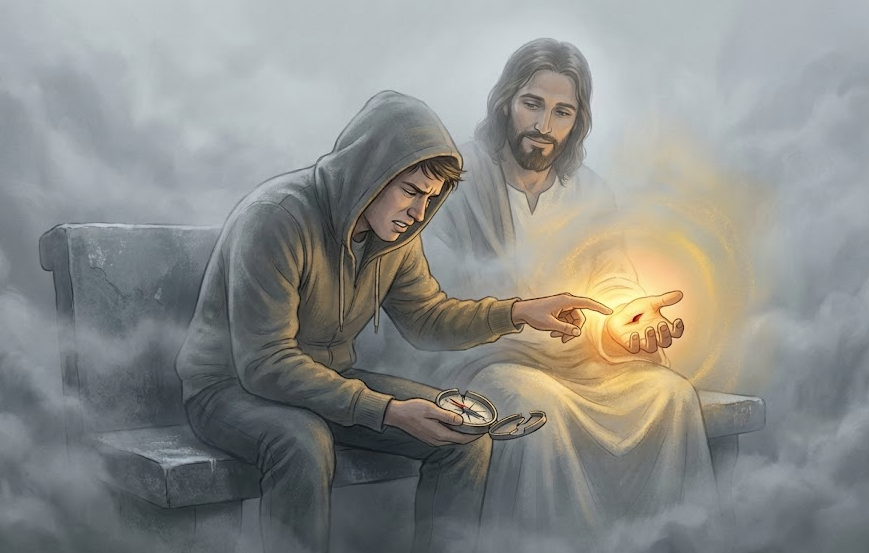
The Journey
For twenty years, I was the “Answer Guy.” I was the small group leader who always had the perfect C.S. Lewis quote for every crisis. I was the one people called at 3:00 AM when their lives fell apart because my faith was the bedrock they could anchor to. I believed in the sovereignty of God with the certainty of gravity.
Then came the summer that gravity stopped working.
It started with a phone call on a Tuesday afternoon. My mentee, Leo—a vibrant, twenty-two-year-old kid on fire for Jesus, days away from leaving for the mission field—had been killed instantly by a drunk driver on his way home from buying toothpaste.
At the funeral, I stood in the pulpit and said all the right things. I talked about mysterious ways and God needing another angel. But as the words left my mouth, they felt like ash. I felt like a salesman peddling a product I no longer believed in.
In the weeks that followed, I entered what the mystics call the “dark night of the soul.” When I tried to pray, it felt like I was talking into a disconnected phone. The heavens were brass. The Bible, which used to feel alive in my hands, now felt like a dusty history book.
I still went to church, but I felt like a spy in enemy territory. I stood during worship, mouthing the words to songs about God’s goodness while my heart screamed, Is He? Is He really? I felt like the biggest hypocrite in the building. The shame of my doubt was heavier than the grief itself. How could I, the Answer Guy, be questioning everything?
The breaking point was a Tuesday night Bible study. We were discussing the story of Lazarus. Someone made a glib comment about how “Jesus always shows up right on time.”
Something inside me snapped. I slammed my Bible shut. The room went dead silent.
“Does He?” I demanded, my voice shaking. “Because He didn’t show up for Leo. He was four days late for Lazarus, and Martha had to watch her brother rot in a tomb. That doesn’t feel like ‘on time’ to me. It feels cruel.”
I stood up, ready to walk out and never come back. I expected rebuke. I expected them to quote Jeremiah 29:11 at me to patch the leak in my faith.
Instead, an older man named Samuel, a quiet guy who rarely spoke, stood up. He walked over to where I was standing, trembling with rage and grief. He didn’t try to fix it. He put a hand on my shoulder and looked me in the eye.
“There’s plenty of room at this table for Thomas,” he said softly.
I collapsed into my chair and wept. It was the first honest moment I’d had with God in three months.
Samuel sat with me. “David, do you think your anger surprises God? Do you think He’s up there clutching His pearls because you have questions? He’s big enough for your doubt. He can handle your pounding on His chest.”
That night didn’t fix everything. The fog didn’t immediately lift. But the shame broke. I realized that doubt wasn’t the opposite of faith; it was often a symptom of a faith that was growing pains—a faith that was being forced to move from easy platitudes to the rugged terrain of real suffering.
I began to pray differently. No more polite prayers. I prayed raw, angry, confused prayers. I prayed the Psalms of lament that demand, “How long, O Lord? Will you forget me forever?”
And in that honest space, slowly, the silence began to change. It didn’t become a booming voice giving me answers. It became a quiet, steady presence sitting with me in the dark.
I am no longer the Answer Guy. I have fewer certainties now than I did twenty years ago. But the faith I have left? It is sturdier. It has been tested in the fire. I have learned that it is better to limp with God in the dark than to strut alone in the light of my own false certainty.
Heart of the Matter
In many Christian circles, doubt is treated like a spiritual virus—something to be quarantined and cured immediately with apologetics. We feel guilty when we have questions, assuming it means our faith is failing.
But the Bible is full of doubters who were beloved by God. Abraham laughed at God’s promise. Job demanded a trial with God. Thomas demanded to see the wounds. Jesus didn’t kick Thomas out of the Upper Room for his doubt; Jesus came to him and offered His scars as proof.
David’s journey teaches us that honest doubt is better than dishonest faith. Pretending you trust God when you actually feel betrayed by Him is a barrier to intimacy. God desires truth in the inward parts (Psalm 51:6). Sometimes, the most faithful thing you can say is, “Lord, I don’t believe this right now. Help me.”
Faith in Action
Today, you are going to pray a prayer with zero editing. No “thees” or “thous,” no trying to sound polite or holy.
Find a private space. If you are angry with God, tell Him. If you feel abandoned, scream it. If you are confused, lay it out.
Write it down if it helps. Start with: “God, if You are listening, here is the raw truth of what I am feeling…”
Trust that He is not offended by your honesty; He is invited by it.
Prayer for the Day
God of the Silence, I confess that I am struggling to see You in the fog. My prayers feel empty, and my heart feels cynical. I want to believe; help my unbelief. Thank You that You are not scared away by my questions. Give me the courage to sit in the “Thomas seat” without shame, waiting for You to show up in Your own time. Until then, help me to hold onto the hem of Your garment, even in the dark. Amen.
Grace Note
“If Christ is the Truth, then the only way to worship Him is to be truthful about where we are and how we feel.” — Mike Yaconelli