
Grace Day #3: The Comfort of Presence

“Praise be to the God and Father of our Lord Jesus Christ, the Father of compassion and the God of all comfort, who comforts us in all our troubles, so that we can comfort those in any trouble with the comfort we ourselves receive from God.” — 2 Corinthians 1:3-4 (NIV)
The Journey
For the first six months after my husband, Arthur, passed away, the silence in my house was so loud it actually hurt my ears. We had been married for forty-two years. Our rhythm was perfect: he made the coffee, I made the toast. He drove, I navigated. He was the noise, the laughter, the storyteller; I was the quiet audience.
When cancer took him, it didn’t just take a person; it took the entire soundtrack of my life.
I stopped going to the Wednesday night dinners at church. I couldn’t stand the pitying looks or the well-meaning people tilting their heads and asking, “How are you holding up, Margaret?” It felt like I was wearing a neon sign that read WIDOW. I withdrew into my shell, convinced that my season of usefulness was over. I was just a leftover piece of a puzzle that no longer had a match.
I spent my days staring at the dust motes dancing in the afternoon sun, waiting for the clock to tick down to a reasonable bedtime. I was spiritually paralyzed, stuck in a loop of “Why him?” and “What now?”
Then came the call from David, our church’s hospital visitation pastor.
“Margaret,” he said, his voice brisk but kind. “I know you’re not ready to come back to services yet. But I have a situation, and I think you’re the only one who can handle it.”
I gripped the phone, ready to say no. “David, I’m empty. I have nothing to give anyone. I can barely get dressed.”
“I don’t need you to give a sermon,” he interrupted gently. “I have a young woman, Jenny. Thirty-two years old. Her husband was in a motorcycle accident last night. He’s in the ICU, and it doesn’t look good. She has no family in the state. She’s sitting in the waiting room alone, staring at the wall. She won’t talk to me. She won’t talk to the doctors. She needs a mother, Margaret. And she needs someone who knows what it’s like to sit in that chair.”
I wanted to refuse. The hospital was the last place I wanted to go—the smells, the beeping monitors, the memories of Arthur’s last days. It felt like walking back into the fire.
“Just go sit with her,” David pressed. “You don’t have to fix it. Just be there.”
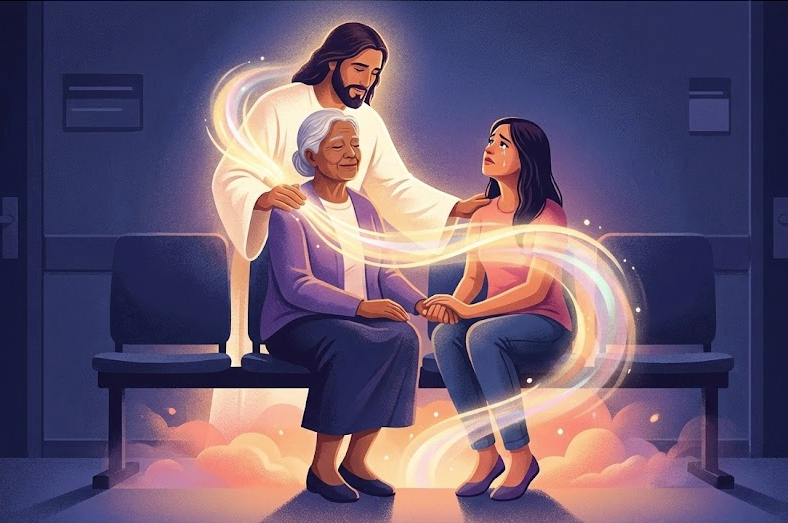
I drove to the hospital with my hands shaking on the steering wheel. When I found the ICU waiting room, I saw her immediately. She looked impossibly young, huddled in the corner of a vinyl loveseat, clutching a styrofoam cup that had long since gone cold. Her eyes were dry and wide, staring at nothing.
I walked over. I didn’t introduce myself. I didn’t quote a Bible verse about God’s plan. I didn’t tell her it was going to be okay, because I knew it might not be.
I just sat down next to her. Close enough to be felt, far enough to give her space.
We sat in silence for twenty minutes. The overhead announcements paged doctors. The elevator dinged. Finally, Jenny whispered, her voice cracking like glass, “I don’t know how to do this.”
I took a breath, reaching past my own grief to touch hers. “You don’t have to know how,” I said softly. ” You just have to breathe for the next minute. And then the minute after that.”
She turned to look at me, really seeing me for the first time. She saw the lines on my face, the sadness that mirrored her own. She saw that I wasn’t a tourist in the land of grief; I was a local.
“Does the panic ever stop?” she asked.
“No,” I admitted. “But you learn to carry it. And you won’t be carrying it alone.”
I stayed with her for six hours. When the doctors came out with bad news, I was the one who held her while she screamed. When her parents finally arrived from out of state at midnight, I was the one who briefed them on where to get coffee and how to navigate the ICU protocols.
Driving home that night, I was exhausted. My body ached. But as I walked into my silent house, I realized something had shifted. The silence wasn’t oppressive anymore; it was just quiet.
For six months, I had been asking God to take my pain away. I thought healing meant going back to who I was before Arthur died. But sitting in that waiting room, I realized that God wasn’t going to waste my pain. He was recycling it. My grief had given me a new language—a fluency in suffering that allowed me to comfort Jenny in a way Pastor David never could.
I wasn’t just a widow anymore. I was a witness.
I started joining the visitation team weekly. I didn’t go to preach; I went to sit. I found that in pouring myself out for others, God was slowly refilling me. I still missed Arthur every single day. The ache was still there. But it was no longer a anchor holding me back; it was a bridge connecting me to others.
Heart of the Matter
When we are in deep pain, our natural instinct is to isolate. We build walls to protect our wounds, thinking we need to be fully “healed” before we can be useful to God or others again. We tell ourselves, “I’m a mess; I have nothing to offer.”
But in the Kingdom of God, your scars are your credentials. Margaret thought her grief made her disqualified for ministry; in reality, it was her greatest asset. Pastor David recognized that theology can explain suffering, but only empathy can comfort it.
The Apostle Paul reminds us in 2 Corinthians that we are comforted so that we can comfort others. It is a divine flow of grace. If you hoard the comfort you receive, it becomes stagnant. But if you let it flow through you to someone else, you find that you are healed in the process. You don’t need to have all the answers. You just need to be willing to be present.
Faith in Action
Scroll through your phone contacts or social media. Look for the person who is going through a trial that you have already walked through (a divorce, a diagnosis, a job loss, a wayward child).
Send them this text today: “I was thinking about you today and what you’re navigating. I know there are no magic words, but I want you to know I’ve been there, and I’m in your corner. No need to reply, just wanted you to know you aren’t walking this alone.”
Prayer for the Day
Father of all Comfort, I often feel like my pain is a prison. I feel like I have nothing left to give. Open my eyes to see the people around me who are hurting in ways that I understand. Give me the courage to step out of my own isolation and offer the gift of my presence. Use my story, my scars, and my survival to bring hope to someone else today. Amen.
Grace Note
“God does not comfort us to make us comfortable, but to make us comforters.” — John Henry Jowett