
Grace Day #6: The Mosaic

“Therefore, if anyone is in Christ, the new creation has come: The old has gone, the new is here!” — 2 Corinthians 5:17 (NIV)
The Journey
For the first year I attended Grace Community Church, I was a ghost. I arrived exactly two minutes after the worship started, slipping into the back row of the balcony. I left during the final “Amen,” ducking out the side door before anyone could shake my hand or ask my name.
I loved the sermons. I craved the peace. But I was terrified of being known.
If these nice people in their Sunday best knew who I really was—or rather, who I had been—the welcome mat would be pulled out from under my feet. My resume didn’t list accolades; it listed a felony conviction. I had spent four years in a correctional facility for distribution of narcotics. I was clean now, three years sober, working a quiet job in a warehouse and keeping my head down. But the shame was a second skin. I felt like a wolf wearing a sheep costume, waiting to be discovered and chased out of the fold.
One Sunday, the pastor made an announcement. “We are launching a new outreach ministry for men transitioning out of rehab and prison. We need leaders. We need men who are willing to walk alongside them.”
My heart hammered against my ribs. I knew that world. I knew the smell of the cells, the taste of the fear, the crushing weight of trying to find a job when you have a record. I wanted to help. But the voice of shame whispered: You? You’re the cautionary tale, Leo, not the leader. Sit down.
I tried to ignore it, but the pull was magnetic. The next Tuesday, I found myself standing outside the pastor’s office door. I knocked before I could talk myself out of it.
Pastor Jim smiled when I entered. “Leo, right? The man in the balcony. I’ve been hoping to meet you.”
I didn’t sit down. I needed to get this over with. “Pastor, I heard about the new ministry. I… I want to help. But you need to know something first.”
I took a breath and spilled it all. The addiction. The arrest. The years inside. The parole officer I still checked in with. I laid my dirty laundry on his pristine desk and waited for the polite rejection. I waited for him to say, “Thank you for your honesty, but we need people with a better reputation.”
Pastor Jim listened without blinking. When I finished, the silence stretched out for an agonizing ten seconds.
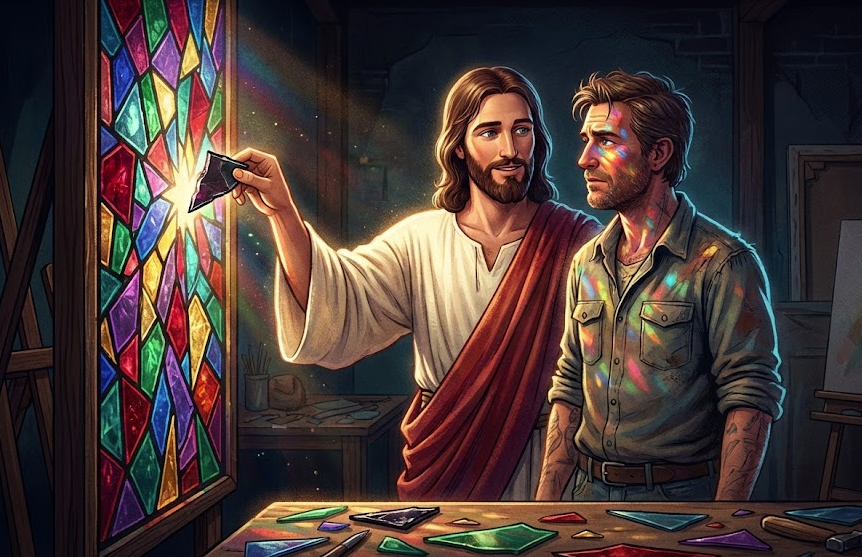
Then, he stood up and walked over to a small table in the corner of his office. On it was a piece of art—a vibrant, glowing lamp made of jagged, uneven shards of colored glass.
“Do you like this?” he asked.
“It’s beautiful,” I said, confused.
“My daughter made it,” Jim said, running a finger over the rough texture. “She dropped a vase a few years ago. It was her grandmother’s. She was devastated. She thought it was ruined trash. But we took the pieces, the sharp edges that could cut you, and we glued them back together in a new shape. We put a light inside it.”
He turned to look at me. “Leo, religion is a museum for unbroken vases. But the Kingdom of God? It’s a mosaic. It’s a collection of broken things put back together to tell a new story.”
He walked back to me and extended his hand. “I don’t need a leader who read about addiction in a textbook. I need a leader who knows the way out of the pit because he climbed it himself. Your scars aren’t your disqualification, son. They are your map. You are exactly who God sent us.”
I shook his hand, and for the first time in three years, I didn’t look at the floor. I looked him in the eye.
That night, I didn’t sit in the back. I went to the recovery meeting. When the circle formed, and men looked around with those familiar, haunted eyes—the eyes of men who think they are trash—I stood up.
“My name is Leo,” I said, my voice steady. “And I’m a new creation.”
I am not defined by the worst thing I ever did. I am defined by the grace that redeemed it. I used to think I had to hide my cracks to belong in church. Now I know that it is through those cracks that God’s light shines often the brightest, guiding others home.
Heart of the Matter
There is a prevalent lie in our minds that says, “I will serve God after.” After I get my act together. After my reputation is restored. After I feel “holy” enough. We view our past mistakes as permanent stains that disqualify us from the Lord’s work.
But if you look at the Bible, it is essentially a Hall of Fame of people with “stained” pasts. Moses was a murderer. David was an adulterer. Peter was a coward who denied Christ. Paul was a terrorist who hunted Christians. God didn’t use them despite their stories; He used them through their stories.
Leo thought his prison record made him a liability. God saw it as a credential for a specific mission. Whatever you are hiding, whatever shame you are carrying, God wants to redeem it. He doesn’t want to erase your history; He wants to rewrite the ending so that your restoration points to His power.
Faith in Action
Shame thrives in secrecy. It dies in the light.
Today, find a way to own a part of your story you usually hide. It doesn’t have to be a public confession. It can be small.
- Tell a friend: “I struggled with [anger/anxiety/doubt] this week.”
- If you are in a position of leadership or parenting, admit a mistake to those you lead. Say, “I was wrong about that, and I’m sorry.”
Watch how your vulnerability gives others permission to drop their masks, too.
Prayer for the Day
Lord of Second Chances, I often feel like I am too broken to be used. I look at my past and see a mess; You look at my past and see raw material for a miracle. Thank You that You do not demand a perfect resume. Thank You that Your grace is stronger than my shame. Take the broken pieces of my life and build something beautiful that points to You. Amen.
Grace Note
“The church is not a museum for saints, but a hospital for sinners.” — Attributed to Augustine / Morton Kelsey