
Grace Day #18: The Chain Breaker

“It is for freedom that Christ has set us free. Stand firm, then, and do not let yourselves be burdened again by a yoke of slavery.” — Galatians 5:1 (NIV)
The Journey
The sound of shattering glass is what woke me up. Not physically—I was already awake, standing in the middle of the kitchen—but spiritually. It woke me up to the monster I was becoming.
It was a Tuesday evening. Work had been a pressure cooker. Traffic was gridlock. I walked into the house with my shoulders tight, carrying a backpack full of stress. My six-year-old son, Leo, was running laps around the island, breathless with energy. He didn’t see me turn the corner with a glass of water in my hand. He slammed into my legs. The glass flew. It hit the tile and exploded. Water soaked my socks; shards scattered everywhere.
And the Red Mist descended.
It was a physical sensation—a hot, rushing wave of rage that started at the base of my neck and flooded my brain. I didn’t check to see if Leo was hurt. I didn’t take a breath. I roared.
“For crying out loud, Leo! Can you just sit still for five minutes? Look at this mess! You are so clumsy!”
My voice was too loud. It bounced off the cabinets. It wasn’t the voice of a father; it was the voice of a tyrant.
Leo froze. He shrank back against the refrigerator. And then I saw it—the look in his eyes. It wasn’t just regret; it was terror. He flinched, waiting for the next blow, waiting for the escalation.
That look hit me harder than the glass. I knew that look. I had worn that look for eighteen years.
I grew up in a house that felt like a minefield. My father was a good provider, but he was an emotional volcano. We walked on eggshells, never knowing if a spilled drink or a C on a report card would trigger the explosion. I spent my childhood making myself small, trying not to detonate the bomb.
I stood at the altar at twenty-five and swore to God, “I will never be like him. My house will be a place of peace.”
But standing in my kitchen, water seeping into my socks, I realized with a sick, sinking feeling that I had become him. The tone, the volume, the immediate jump to shaming—it was all programmed into my firmware. I was inheriting the wind.
I turned away from Leo, my hands shaking. “Don’t move,” I whispered harshly. “You’ll step on glass.”
I walked out the back door into the garage. I sat on a cooler and put my head in my hands. The shame was suffocating. I felt like a failure. I felt like the chain of anger was wrapped so tightly around my DNA that I couldn’t breathe.
“I can’t stop it,” I confessed to the dark garage. “It’s in my blood.”
I sat there for ten minutes, letting the adrenaline fade into grief. I remembered a sermon about “generational curses”—not as some spooky hex, but as the natural consequence of learned behavior passed down like a family heirloom. But I also remembered the promise: Christ sets us free.
I realized I had been trying to fight this battle with willpower. I thought if I just tried hard to be nice, I would succeed. But I didn’t need willpower; I needed a new nature. I needed to invite the Holy Spirit into the split second between the trigger and the reaction.
I stood up. I couldn’t change the last ten minutes, but I could change the next ten.
I walked back inside. My wife had cleaned up the glass. Leo was sitting on the couch, looking at his knees, silent.
My father never apologized. In his worldview, parents were gods and children were subjects. Apologizing showed weakness.
I walked over to the couch and knelt down so I was eye-level with Leo.
“Leo,” I said softly.
He looked up, wary.
“Daddy was wrong,” I said. The words tasted foreign, but I forced them out. “It was an accident. You didn’t do anything wrong. I was stressed, and I lost my temper, and I scared you. That is not your fault. It is my job to handle my big feelings, not yours.”
Leo’s eyes widened. This was off-script.
“I am so sorry,” I continued. “Will you forgive me for yelling?”
The tension left his small body instantly. He threw his arms around my neck. “I forgive you, Daddy.”
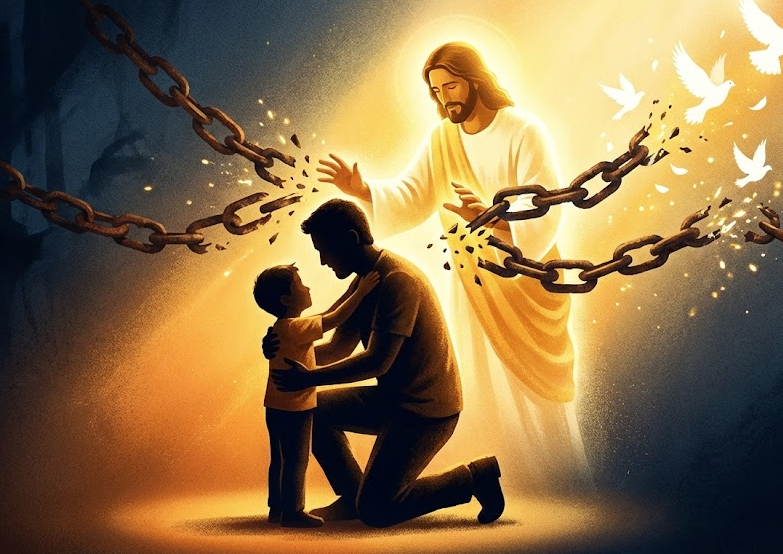
I held him tight, tears pricking my eyes. In that hug, I felt something snap. Not the glass, but the chain.
It wasn’t a magic fix. I didn’t become a saint overnight. I had to go to counseling. I had to learn to recognize the “Red Mist” and walk away before I spoke. I had to ask my wife to hold me accountable.
But that night was the turning point. I realized that breaking the cycle doesn’t mean being a perfect parent who never gets angry. It means being a humble parent who knows how to repair the breach. It means showing my son that while I may struggle with the sins of my father, I serve a Father in Heaven who is rewriting my story, one apology at a time.
I am not just raising a son; I am raising a future father. And the legacy stops here.
Heart of the Matter
Generational patterns are powerful forces. Whether it is anger, anxiety, addiction, or emotional distance, we often find ourselves reacting to life exactly the way our parents did, even if we hated it growing up. Psychologists call it “modeling”; the Bible calls it the “sins of the fathers.”
But the Gospel offers a “Interrupt.” You are not a slave to your upbringing. You have been adopted into a new family line. You have the DNA of God through the Holy Spirit.
David’s victory wasn’t that he never got angry again; it was that he repaired the damage. His father never apologized; David did. That small pivot changed the trajectory of his son’s life. Grace allows us to be honest about our struggles without being defined by them. You can be the Chain Breaker in your lineage, not by being perfect, but by being humble enough to let Jesus stand between you and your history.
Faith in Action
If you snap at someone today (a child, spouse, or friend), practice the Art of Repair immediately.
Do not say: “I’m sorry I yelled, but you made me mad.” (That blames them).
Say this instead:
- Own it: “I lost my temper. That was my reaction, and it was wrong.”
- Validate them: “I imagine that was scary/hurtful for you.”
- Ask: “Will you forgive me?”
Memorize this script so you can use it when your brain is foggy with emotion.
Prayer for the Day
Heavenly Father, I thank You that I am a new creation. I surrender the patterns of my past to You. Where there was anger in my childhood, let there be patience in my home. Where there was silence, let there be connection. Give me the humility to apologize when I fall short. Empower me by Your Spirit to build a new legacy of grace for the generations coming after me. The chains fall off today. Amen.
Grace Note
“It is easier to build strong children than to repair broken men.” — Frederick Douglass